
How to think and operate
when the rules around you have changed and
the internal logic of the system is lost
HRO is a way of thinking and a way of organizing.
Steps to understand HRO
The basics explained.

What is HRO?
High Reliability Organizing (HRO) developed as a means to make an organization or unit stronger. In its natural state we historically found it in environments of danger or uncertainty such as military combat, firefighting, or business activities. While proactive components (plans and anticipation) and reactive components (after action reviews) are necessary parts of HRO, High Reliability itself derives from the ability of the organization and individuals to interact in real time with uncertainty or threat from the external environment.
HRO describes on the organizational level the structure necessary for High Reliability, on the social level the collaboration found in response to threat, and on the individual level the satisfaction of problem solving while modulating threat responses. These three levels facilitate the free flow of information and the migration of action for a quick response to, and interaction with, surprise or accelerating events. The High Reliability Organization emerges from the interactions between people responsive to the environment in an organization that allows this.

The Problem of HRO?
The High Reliability Organization is commonly described as an organization that performs high risk work but without rare, catastrophic events. Researchers, as outside observers, have identified principles and characteristics to describe or characterize HROs but these tend to be distinct, and sometimes complex. Some of these principles are directed toward the organization’s structure and while some describe group interactions. Even more complex descriptions cover the processes of a crisis. While researchers attempt to describe how to move toward High Reliability they have not described how HROs originally formed. The overall research is unsettled to produce confusion between structural and functional principles, how to change people and organizations (most work describes imposed change), and the variety of the principles are assumed to be continuously connected. This has created confusion and gaps in our knowledge of HRO.
As longtime practitioners of what is now called High Reliability we believe these knowledge gaps come from unrecognized concepts and principles. These gaps can be connected when we view HRO as derived from specific attitudes and the importance of engagement of the situation when surrounded by uncertainty. Also inadequately discussed are descriptions of decision making with imperfect information along with understanding the ability of the individual to modulate the brain’s threat, or fear, response.

Why Consider HRO?
In the world today we deal with uncertainty and threat. This can be on the personal level of family or job, on the business level of the economy, or in geopolitics. High Reliability, evolved for optimal performance in an environment of uncertainty and threat, can strengthen a person’s performance, improve the function of a team, and move an organization forward through uncertainty.
HRO, derived from human reasoning and behavior, looks at the commonality of decrements in quality, resilience, and safety. After all, these differ only in what is harmed: the product, the system, or a person respectively. It appears intuitively obvious that resources used for Quality, Resilience, or Safety (the QRS Complex) will not be available for Productivity. However, when done correctly Quality, Resilience, and Safety will improve along with Productivity. This is the process of High Reliability.
Tactical Improvisation: San Bernardino City Fire Department
Please feel free to download and read the following PDF submitted regarding the "After-Action/ Comprehensive Analysis of the Active Shooter Incident Response by the San Bernardino City Fire Department." The full 117-page official report on the attack—good reading as a training document—can be accessed free of charge with a click of the download button below.

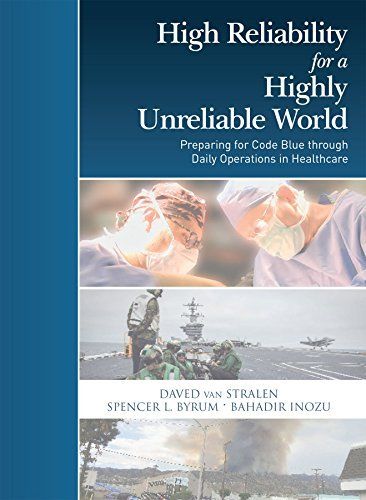
High Reliability for a Highly Unreliable World: Preparing for Code Blue through Daily Operations in Healthcare
Authors Daved van Stralen, MD, FAAP; Spencer L. Byrum; and Bahadir Inozu, PhD, are experts in the art and science of High Reliability Organizing (HRO). They have, in their diverse and successful careers, applied the fundamentals of the HRO system to aviation, healthcare, public safety, manufacturing, and a multitude of other industries. Among these industries, HRO’s applications in healthcare have been garnering the most attention recently.
In this new guide to the principles of HRO, the authors explore its uses in healthcare and list the many ways industry leadership can benefit from its implementation. In addition to HRO’s many benefits, this new guide also explores:
- The five HRO principles
- HRO in healthcare environments
- The problems HRO solves
- Boyd’s OODA loop
- Decision making in healthcare
- Threat responses
- Leadership models
- Organization culture, andmany other important fundamentals
.
HRO is an effective way an organization can respond to crisis, chaos, and adversity. It gives leadership, management, and all levels of the organization a way of processing challenges and overcoming them as a single unit.
With the help of these industry experts, discover how HRO helps you learn and grow as team member, manager, and leader
'Dirt bike riding in the desert. I asked if he had ever driven up a box canyon. "Yes," he answered. "Why?"
HRO is a way of THINKING and a way of ORGANIZING.


"A little learning is a dangerous thing; drink deep, or taste not the Pierian spring: there shallow draughts intoxicate the brain, and
drinking largely sobers us again."


“What is learned today must explain yesterday or be used tomorrow."
I will only teach what will help.